

I wanted to build my own app without knowing how to code
As a CPO, I spend my days framing products for other people. I wanted to build my own without writing a line of code: the story of a vibe-coding side project, between the thrill of the first prototype, the AI's hallucinations and the bug loops.
Building for myself, for once
The idea is simple: you give the title of a book you enjoyed, and the app recommends three others. I read a lot of children's and young adult fiction, I like sharing that with my children, and I wanted a tool that would find books I'd like without spending hours on it.
It exists now, it's called Nextie, and you can try it here: nextsoulbook.lovable.app. Here's how I got there.
The starting problem is that I don't know how to code. My last line of code dates back to 2006, for my thesis. So it's 100% vibe coding: I explain what I want to an AI, it generates the code, I test, I fix, I start again.
In a few weeks, there was a first idea abandoned in one evening, a pivot, a prototype that worked straight away, AI hallucinations, looping bugs, a change of tool, and plenty of doubts. But I'm having fun and learning a lot.
I could have stopped before I started
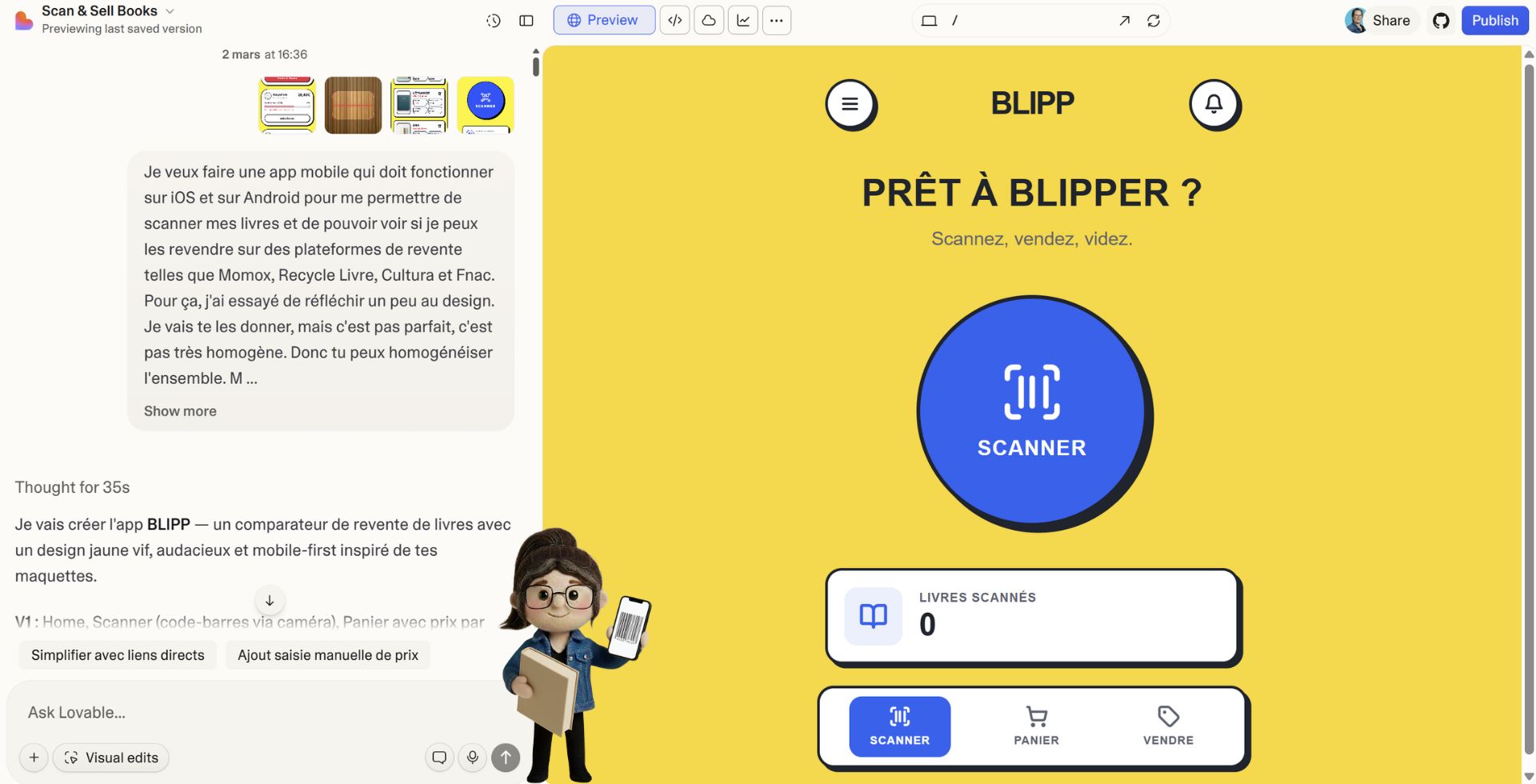
My first idea didn't survive one evening. I wanted a buy-back price comparison tool for books: you scan a book, and the app tells you where to resell it at the best price, Momox, Recycle Livre, Cultura, Fnac. I launched the project at 16:36, full of enthusiasm.
Momox worked straight away, a public API, real prices. Except that a comparison tool with a single source is useless. And then everything unravelled: Recycle Livre on a private API, Cultura blocked by a captcha, Fnac the same, Gibert with no online estimate, Ammareal in vouchers only. I even asked the AI to look up the prices. It made them up.
At 19:55, I wrote 'this is dead for my app'. That's one of the limits of vibe coding: when the AI tells you it's stuck, you don't have the skills to find a workaround on your own. You depend entirely on what the tool can do. An hour later, I was opening a new project.
The app that appeared in four minutes
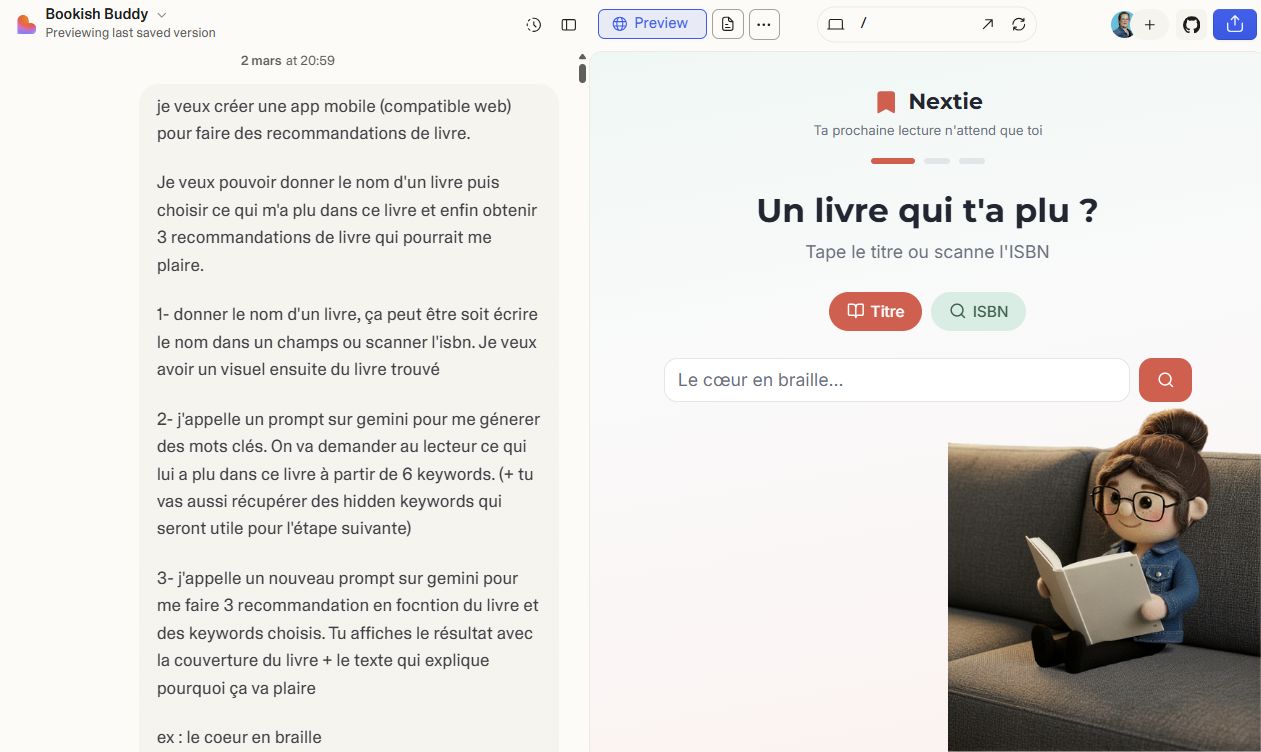
After twenty years watching teams battle to ship software, I saw an app appear in four minutes.
I opened Lovable, described what I needed in about a dozen sentences, and waited. Four minutes later, I had three screens, book covers, recommendation categories. Something that looked like a real app, without a single line of code written.
The feeling is disbelief mixed with excitement. Not 'this is fast', more 'this opens so many doors that I no longer know where to start'. On this platform, 100,000 projects are created every day. How many reach production? Nobody says.
When the AI makes things up with total confidence

My recommendation app was recommending books that didn't exist.
At first everything seemed to work: titles, covers, recommendations. Testing the full journey, I saw that some titles didn't exist, that some covers didn't match the right book. I asked the AI to find the ISBN of each book. It was making those up too.
A study showed that when an AI model hallucinates, it uses a tone 34% more assertive than when it tells the truth [1]. The more it invents, the more sure of itself it sounds. That's exactly what I experienced: everything looked correct, none of it was.
For me, it was a side project, a Saturday evening. But the real question lies elsewhere: on a company project, with real code in production, how do you verify what the AI produces?
The infernal loop
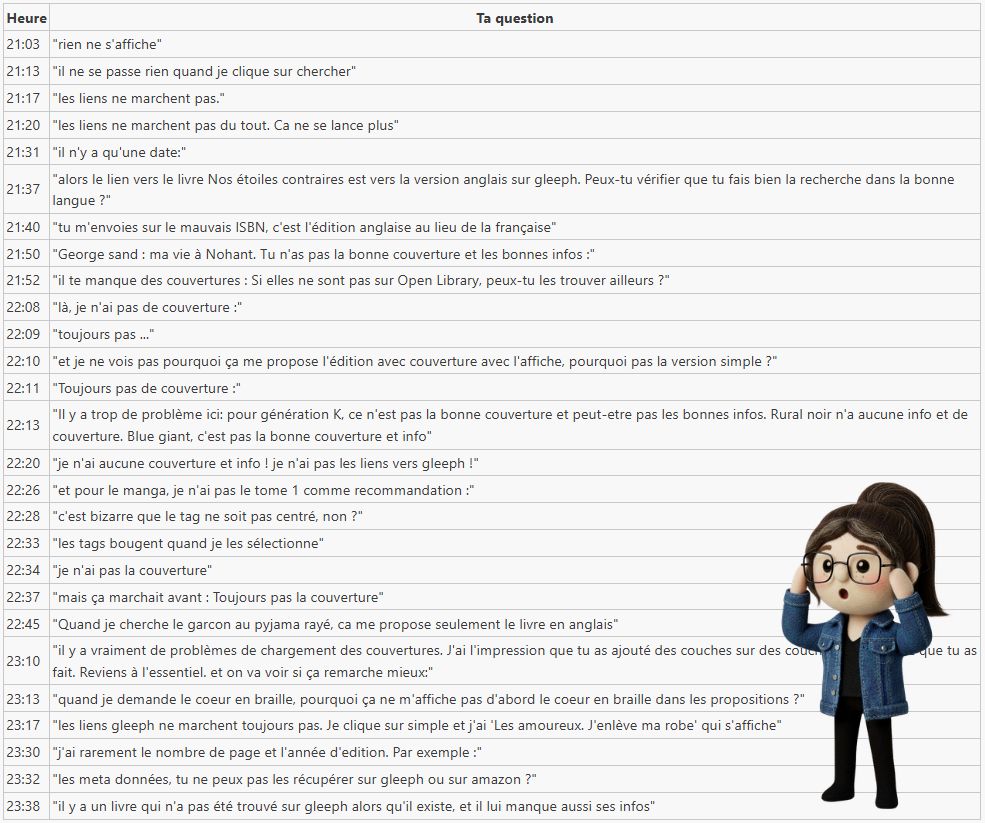
The best thing that happened to me was running out of tokens.
In one evening, I reported 27 bugs to the AI. The wrong cover, the link pointing to the English version, the made-up ISBN, the cover that disappears when another one is fixed. Each time, the AI fixed it in 30 seconds. So you keep going. 'One more, come on.'
In fact, I was fixing one bug and creating two more. But since it took 30 seconds, I felt like I was making progress. Then no more tokens. In the moment, frustration. In hindsight, a good thing: it forced me to let go of the keyboard and think. Do I put more money into an endless loop, or do I change my method?
Taking back control with tests
I'd already been using Claude for a few weeks, but as an enhanced assistant: I asked questions, I organised my notes, I had my own little in-house assistant. Code, no.
After my 27-bug evening, I asked a support community: how do you connect my Lovable project to Claude Code? Simple answer: sync your project with a GitHub repository, and you'll be able to work on it directly. I worked out how to do it. And then I didn't dare take the plunge. I asked developer friends. They just told me 'ask Claude'.
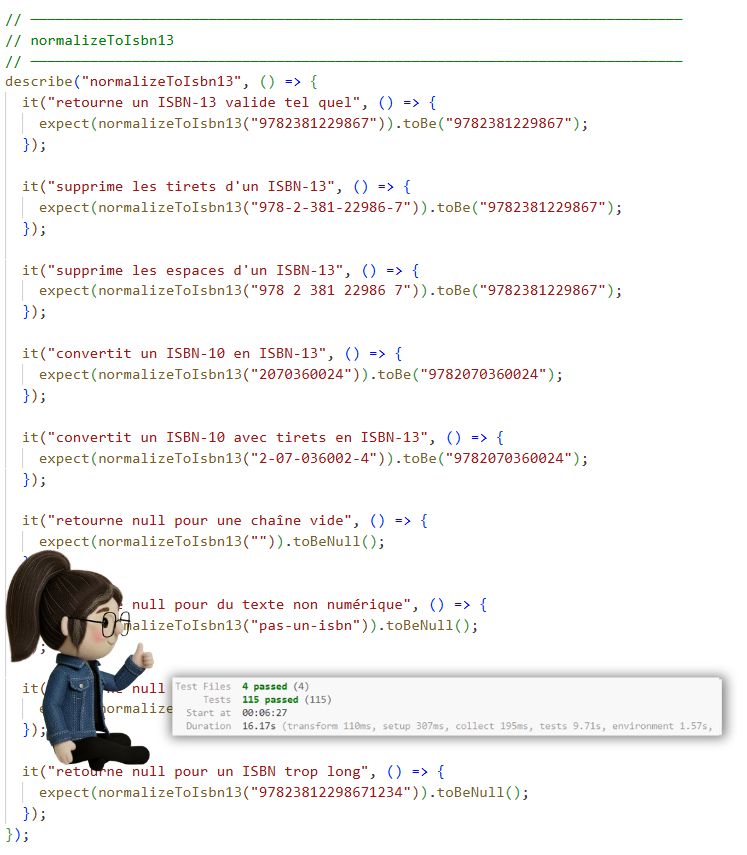
So I tried. The first thing I asked, once my environment was set up: add me tests on everything you can test. The idea: if I can't stop things from breaking, at least I'll know which ones. That's when I felt I was starting again on a solid footing. A real change of method.
The blunder only a beginner could make
A mistake a developer would never have made. It took me three weeks to realise it.
I was opening my code editor from any folder, without thinking, focused on my conversation with the AI. Until the day I thought: 'that's odd, how is the assistant organised? Sometimes I find what I'm looking for, sometimes I don't.' Three weeks to understand that the AI's context is tied to the project I open. Then half a day to put everything back in order.
People say you can do anything with AI. In truth, when it works well, it's because there's real expertise steering it.
Structuring it, like in a company
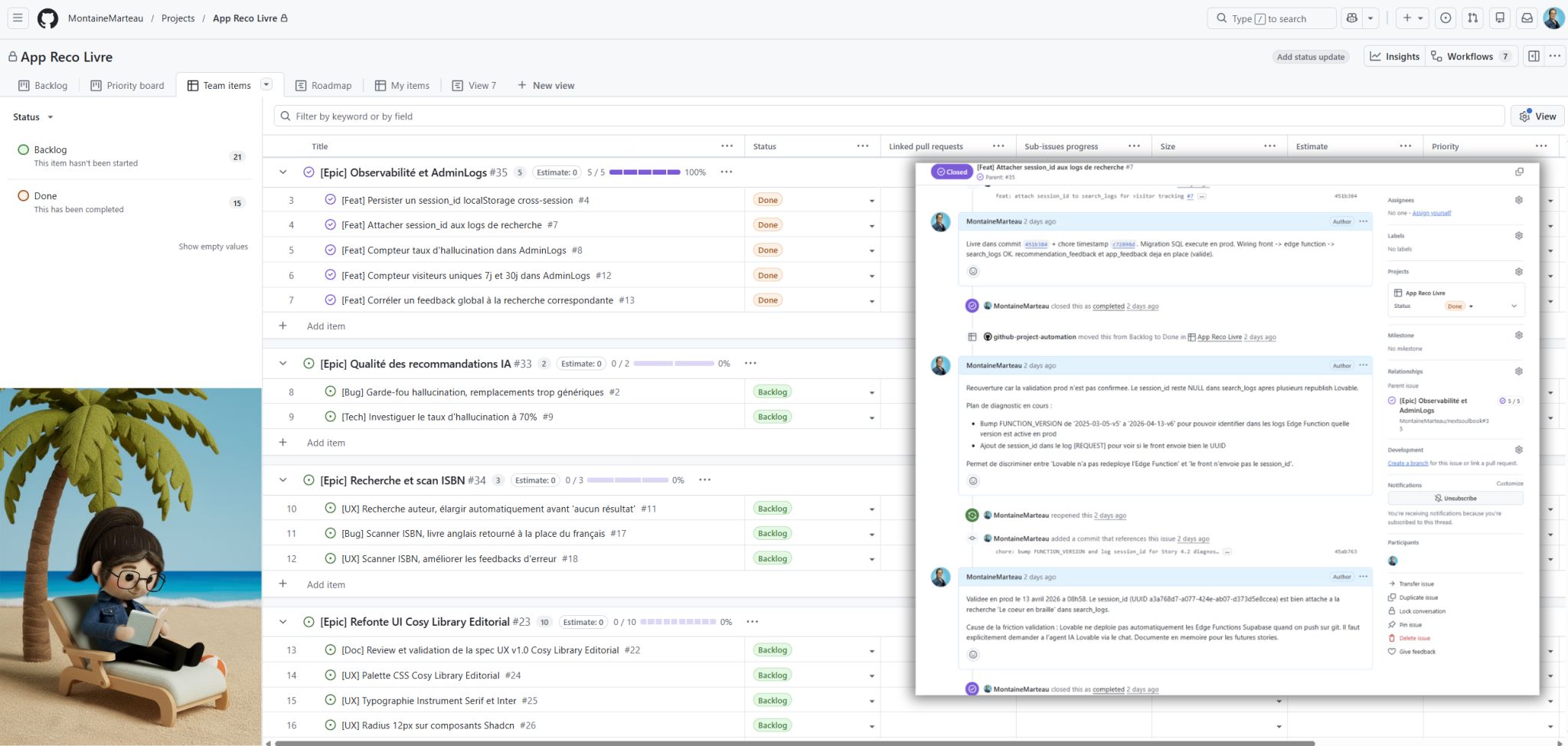
My side project also lets me test methods I could use in a company. That week, I tried an AI agent framework that structures a product project, from the vision through to the code commits. Clearly oversized for an app like mine, but instructive.
Since my project already existed, the tool first analysed what was there, then took me through a structured interview: vision, metrics, user journeys, scope, requirements. Funny, because on my side project I was in 'having fun' mode, I hadn't structured any of that. It forced me to sit down, to name where I want to go and why. Then it handles the part I find thankless: writing the user stories, technical breakdown, architecture. The bulk of the work is done, I adapt and polish.
What makes me think is the pace. Execution is so fast that you have to decide when to stop and step back. Impose review pauses at chosen moments, or let it run to the end to judge on the results? I haven't decided yet.
And now, on pause

Since then, the list of tools I've tried has grown: a Figma account for design, Claude's design capabilities, with real results to show for it. There's always a new train to catch, and I'm running a bit behind.
So for now, my app is on pause. Like many side projects: not abandoned, just waiting for the next window.
What I take away from this journey: you pivot faster than you'd think, a tool that speeds up the start doesn't speed up the finish, and an AI that produces quickly also produces mistakes that look right. Things I knew in theory as a CPO, and lived differently, without a safety net.
You can try Nextie here: nextsoulbook.lovable.app. And if you have a side project on the go, tell me about yours.
Sources and references (1)
- AllAboutAI, AI Hallucination Report 2026. allaboutai.com
Product, innovation and MedTech field notes
Frameworks, methods, field feedback. Let us talk for 30 minutes to see what applies to your context.
Book a slot →
Thank you. Your comment will be published after review.