
Market research and opportunity assessment for health software.
Before launching a new product, a new product line or a subsidiary: the market sized on French public health data, the competitors, buyers and users interviewed, prototypes tested, and a written recommendation with its evidence.
- Public health dataMarket sized
- 4 to 5 interviewsFieldwork, and a prototype test
- Written, with its evidenceRecommendation
 Approved for the Innovation Tax Credit (CII)
2026-2030
How it works.
From scoping to recommendation.
Seven steps, with the example of a recent study: what I do, and what comes out of it.

The question
Should we build a coding tool for oncology?
Scoping : I set out with you the question to study.
One hour with you: the decision to make, the assumptions, the people to interview.
What comes out the question in writing, the assumptions
The market
€3m to €34m a year
just over 300 buyers; target: about 140
Market : I study the market.
French public health data: ATIH hospital data and ScanSanté, national health insurance, INCa, DREES. Facilities, volumes, amounts.
What comes out the total market, the target, the price assumptions

Competition
≈ 20 offers
taken: general coding; open: oncology
Competition : I map the competing offers.
Installed software, new entrants, home-made workarounds: who holds what, and where there is room.
What comes out the map of positions
Claire, coder
“Why doesn’t this information show up?”
Users and buyers : I let those who use, decide and pay speak.
First what they say in public: profiles drawn from published statements, each quote with its source. Then 4 to 5 interviews, recruited with you, on what public data does not say: who signs, at what price, from which budget. An AI-simulated panel prepares these interviews, without replacing them.
What comes out user profiles, the purchasing chain checked, the objections
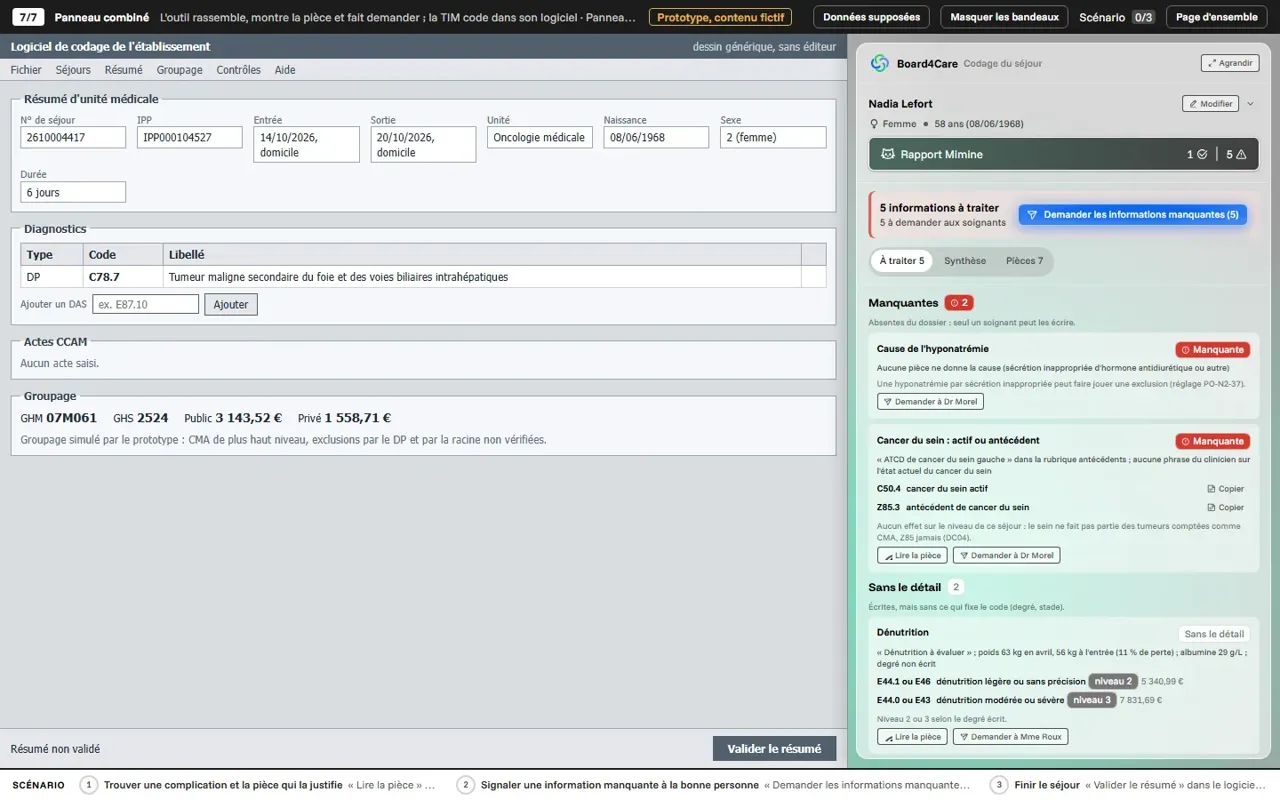
Three prototypes
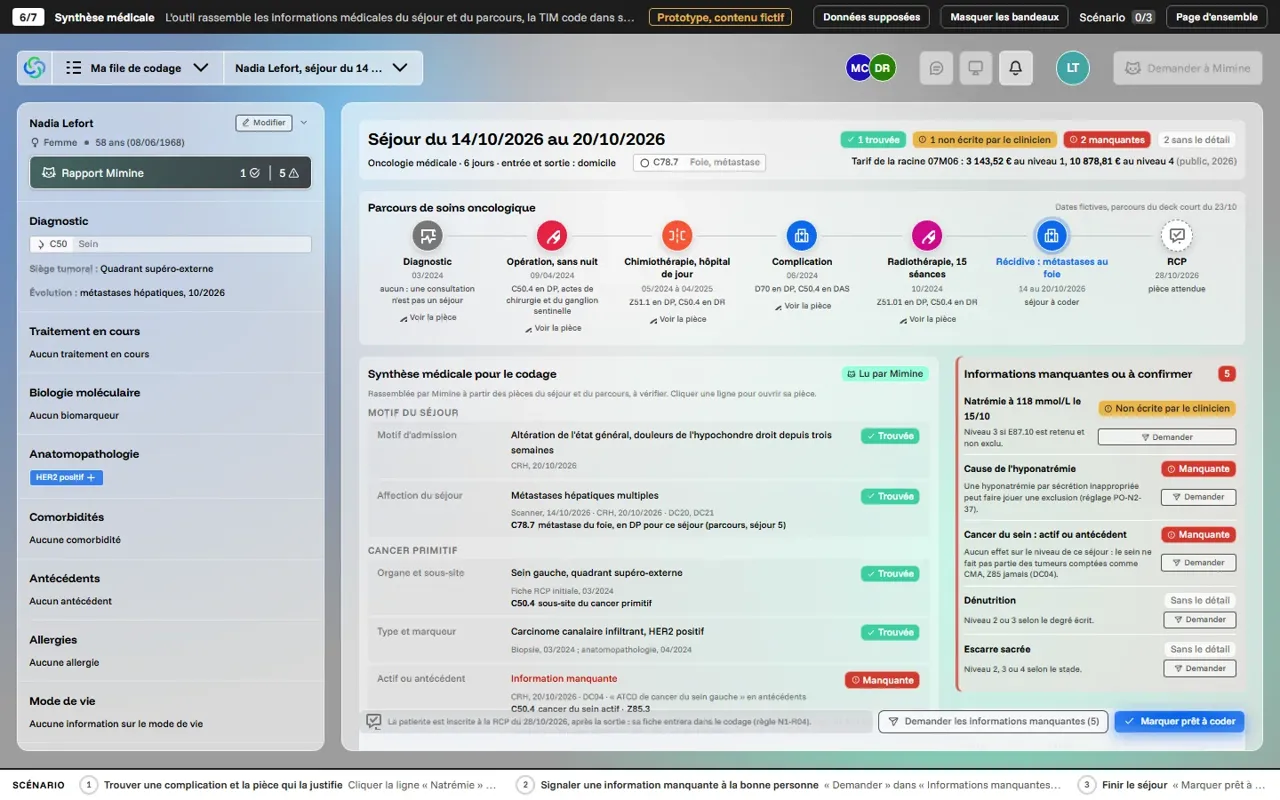
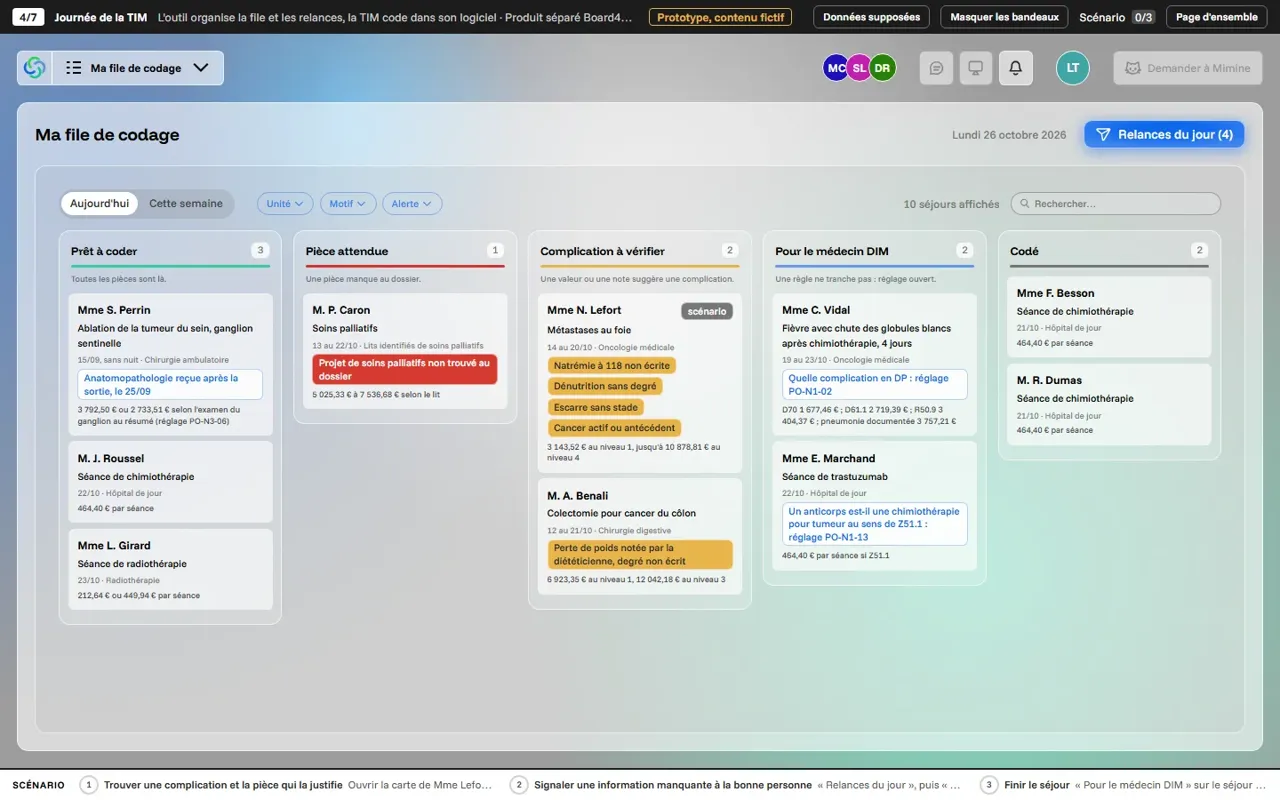
fictitious patients, online for the team
Prototype : I design the missing screens.
The key screens, clickable, with fictitious content.
What comes out a prototype online, a test script
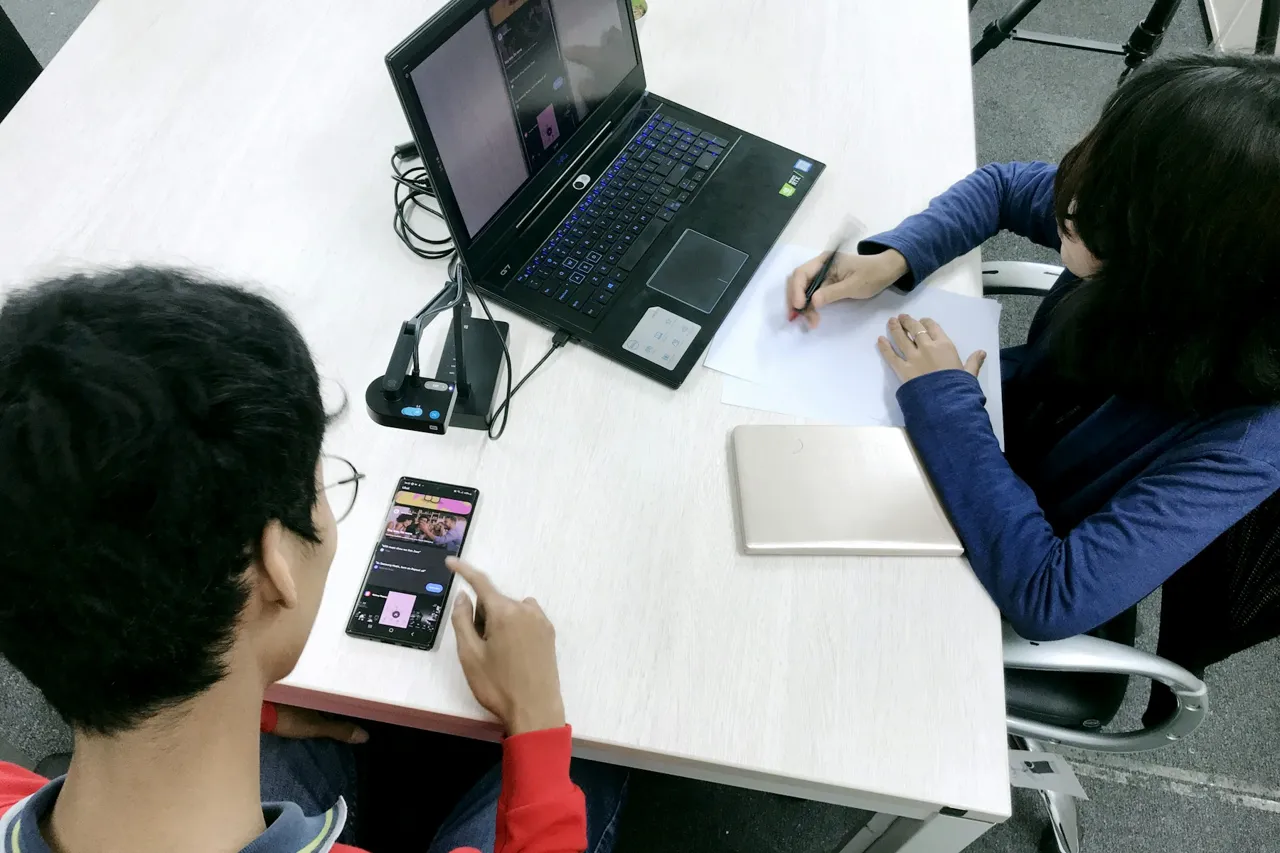
The test
What users understand, what blocks them
Test : I have the screens tried by the people who will use them.
The same test script for each person: what they understand, what blocks them.
What comes out assumptions confirmed or ruled out
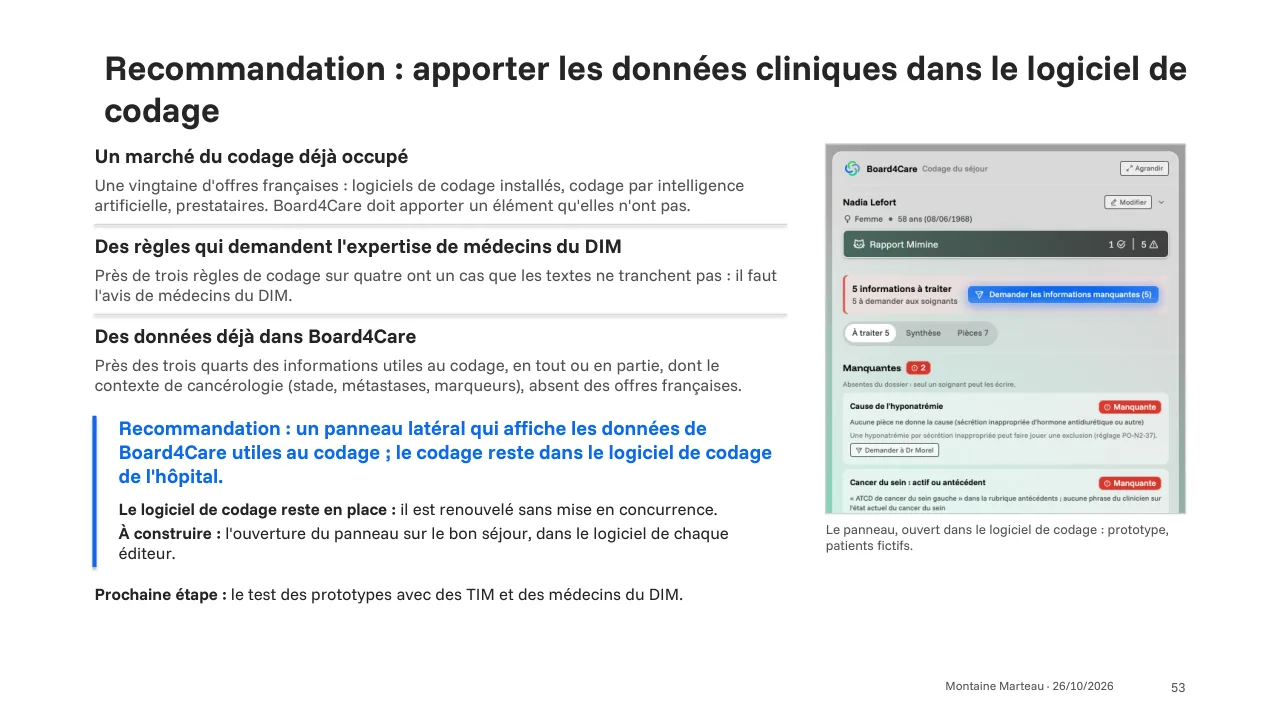
Recommendation
A side panel in the coding software, not a complete tool.
Recommendation : I write what to do, with its evidence.
Presented to leadership in one hour.
What comes out a written recommendation, its evidence
To decide as a team:T+30The Decision Sprint, a 3-day workshoptplus30.tech→
What you receive.
The file from a recent study (extracts).
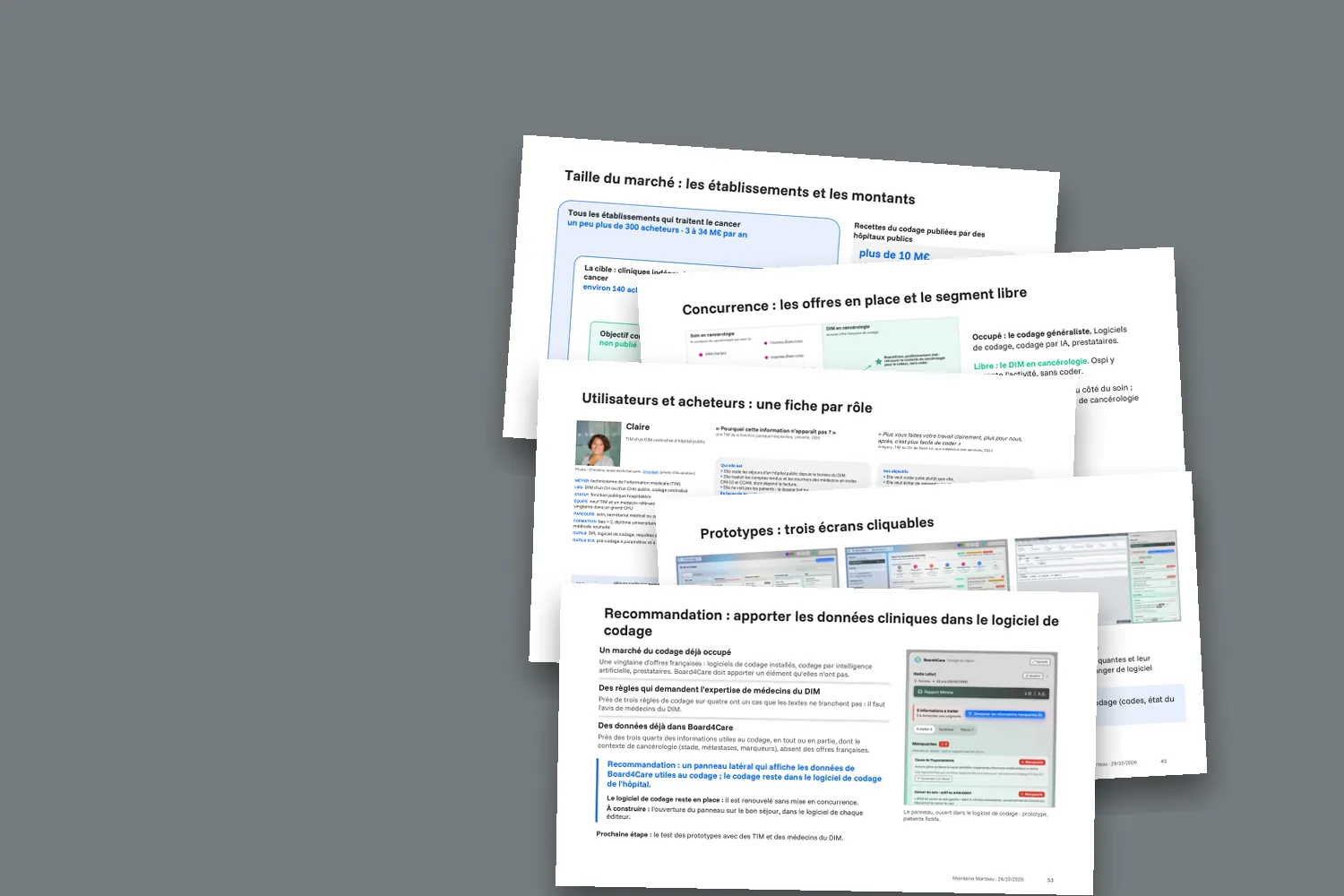
Study of hospital coding in oncology, October 2026: a deck of about sixty pages and three prototypes. Extracts published with the company's agreement (in French).
View 1 of 10
p. 1

Opportunité DIM
DIM: département d’information médicalethe hospital department that codes each stay for its payment
Montaine Marteau · 26 October 2026
The findings deck, delivered on 26 October 2026.
Contents59 pages, eight parts and the appendices
Contents59 p.
- 01How a hospital stay is paidextracts : p. 3p. 2 à 11 10 p.
- 02The marketextracts : p. 13, p. 14, p. 17p. 12 à 20 9 p.
- 03The usersextracts : p. 23, p. 24p. 21 à 26 6 p.
- 04The client's datap. 27 à 31 5 p.
- 05The coding algorithmp. 32 à 38 7 p.
- 06The prototypeextracts : p. 40p. 39 à 44 6 p.
- 07The testp. 45 à 50 6 p.
- 08Findings and deliverablesextracts : p. 52p. 51 à 53 3 p.
- Appendicesp. 54 à 59 6 p.
Delivered with the deck: nine documents and three clickable prototypes.
The contents of the deck, part by part, with its pages. The pages published as extracts are marked.
UnderstandHow a hospital stay is paidp. 3
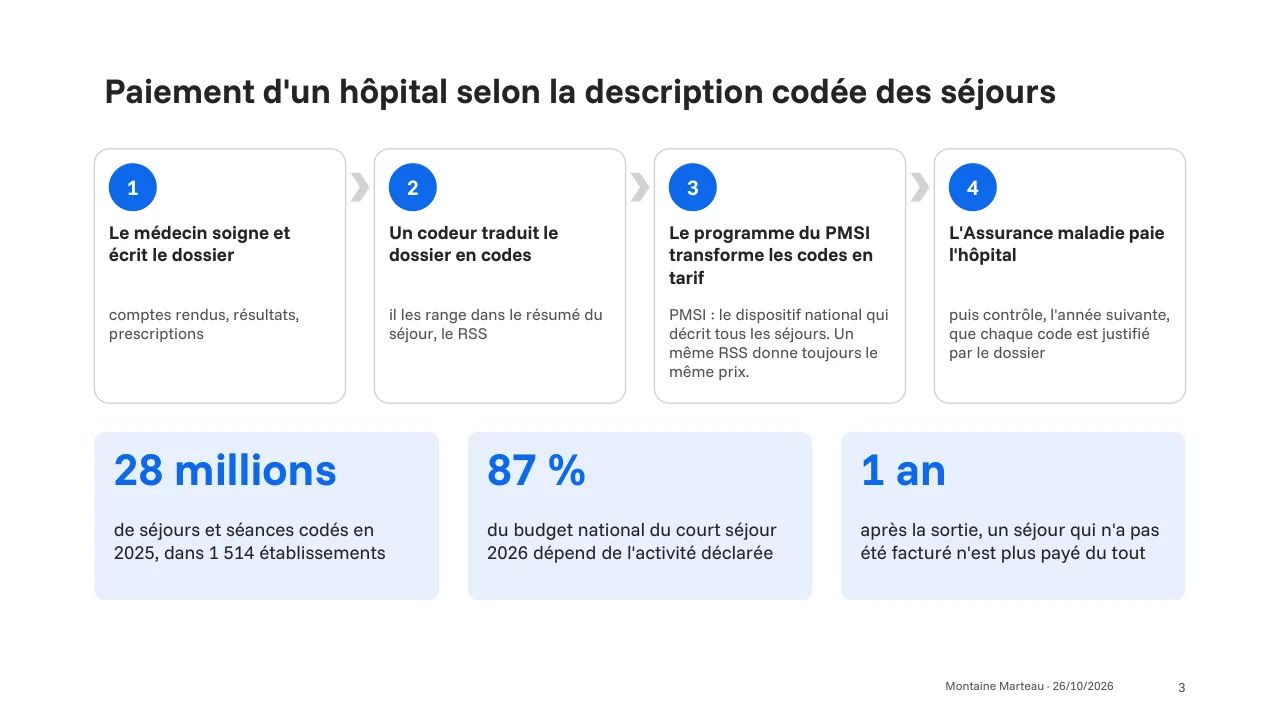
The flow of money, from the doctor writing the record to the tariff paid by national health insurance: the basis for knowing who gains what from coding.
SizeMarket segmentsp. 13
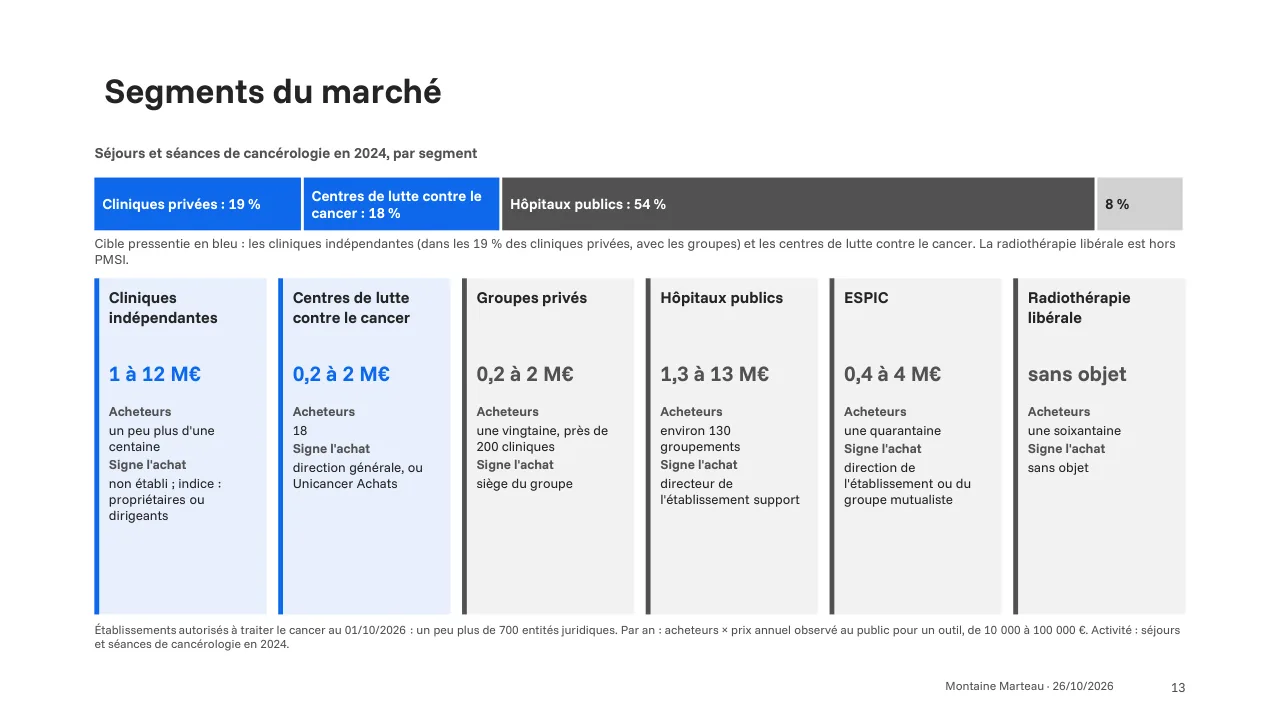
Oncology stays and sessions in 2024, by type of facility, taken from public data.
SizeBuyers and amountsp. 14
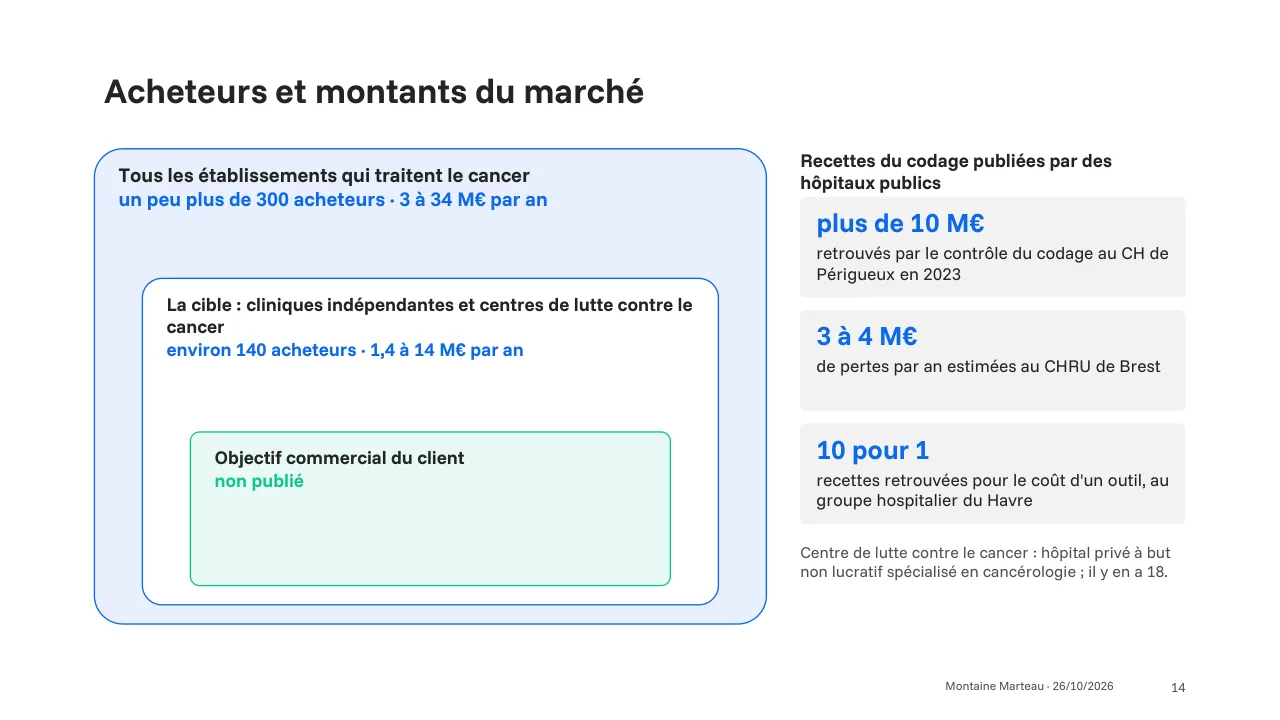
The total market, then the target: facilities counted in the PMSI, amounts at the public prices of existing offers. The client's sales target is masked.
PositionMap of offersp. 17
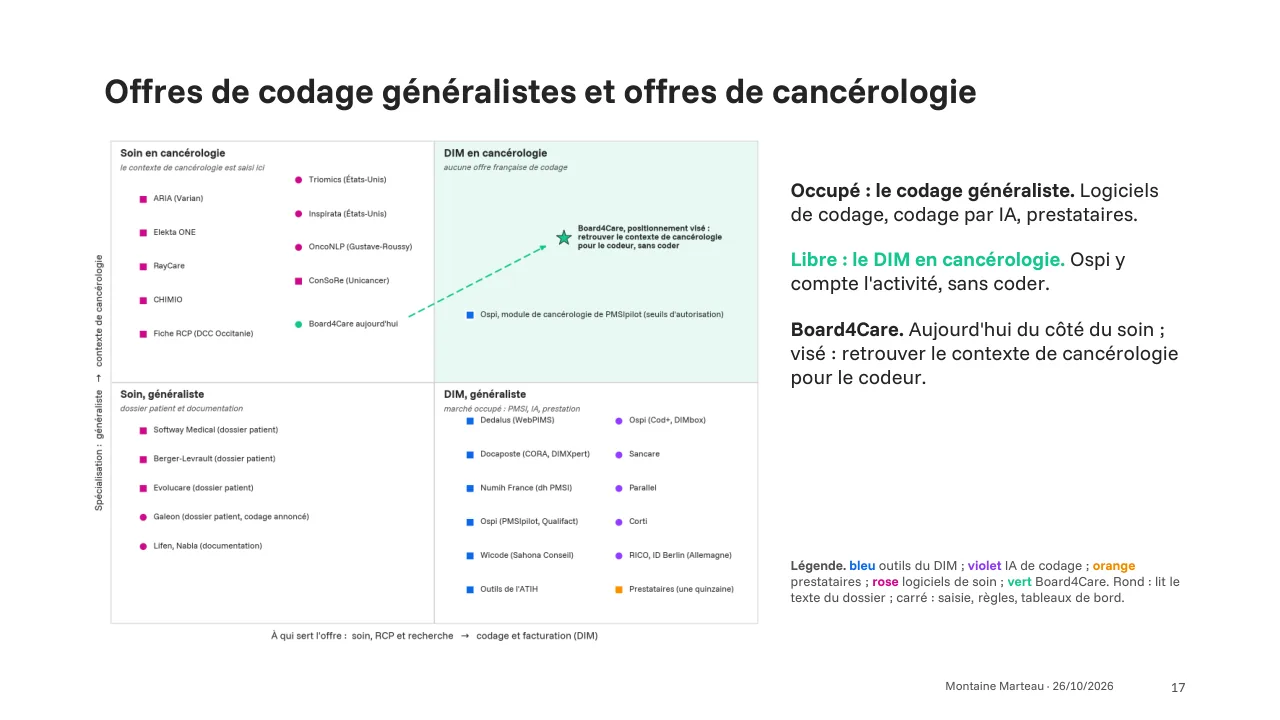
Coding offers, general and oncology-specific, positioned: where the market is taken, where there is room.
KnowA user profilep. 23
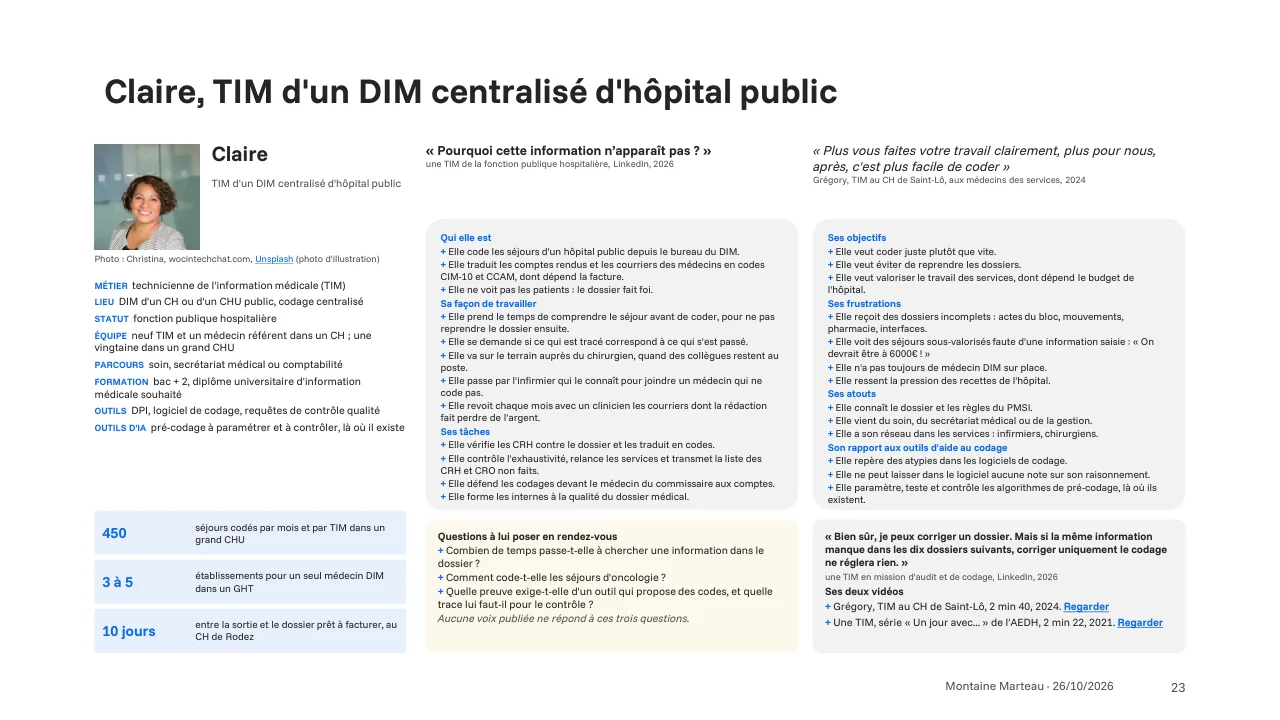
Claire, a coder in a public hospital: one of the five profiles drawn from published statements. Illustration photo.
CheckThe sources of the user profilesp. 24
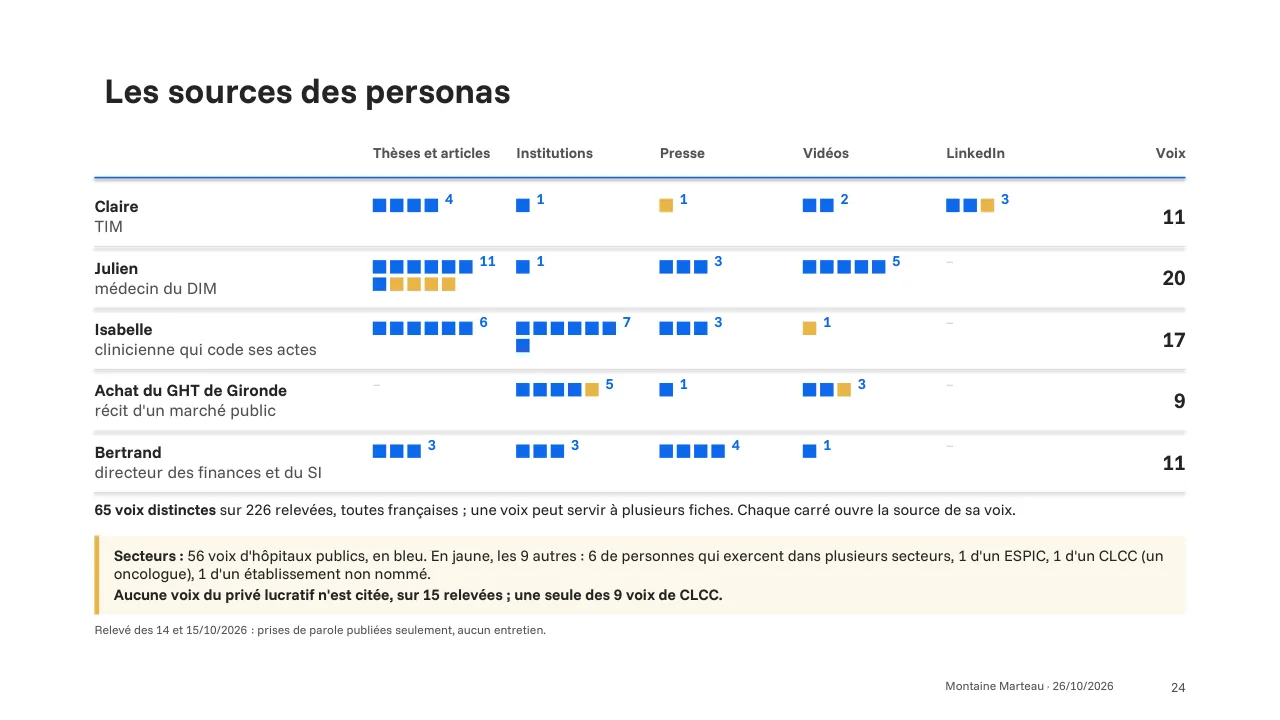
The sources of each profile, by type: theses and articles, institutions, press, videos, LinkedIn. 65 distinct voices, kept out of 226 collected; in the deck, each square opens its source.
ShowThree prototypesp. 40
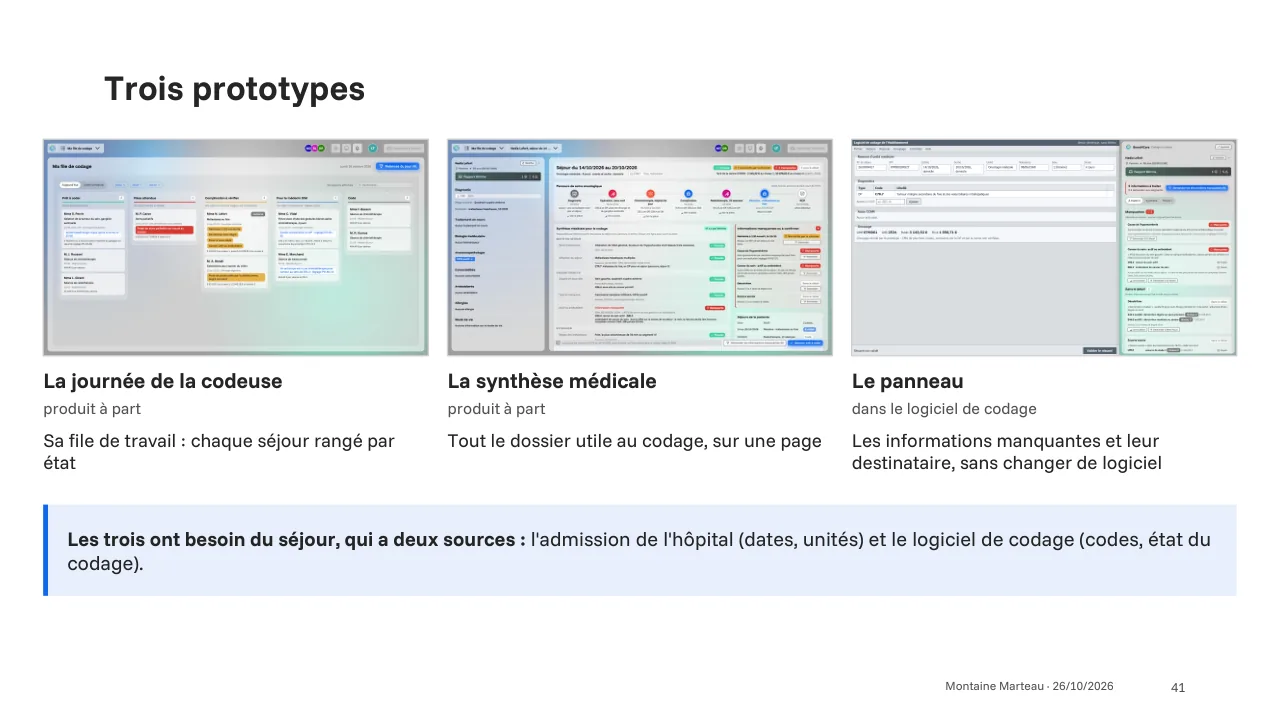
Three screens for the coder, clickable, with fictitious content, put online for the client’s team.
DecideThe recommendationp. 52
The written recommendation and its three pieces of evidence: a crowded market, rules that need doctors’ judgement, data already in place.
Before you start.
FAQ
Answers to the questions I am asked most. Another one in mind? Ask it during the call.
How much does a study cost?
The price depends on the topic and the number of interviews. It is set during scoping: a quote after the 30-minute call.
How long does a study take?
The timeline is set during scoping. It mostly depends on how long it takes to recruit the people interviewed.
Who carries out the study?
I lead every study myself, from start to finish. Fractional CPTO, engineer and PhD by training, more than 25 years in Tech and MedTech, mostly in product leadership, including fourteen years on radiotherapy software.
Does my information stay confidential?
Yes. The study and its deliverables belong to you. Nothing is shown elsewhere without your written agreement, as with the example published on this page.
What about regulation?
The study lists the points to check: medical device status, health data, hosting. It does not replace a regulatory file and promises neither a timeline nor an outcome.
Could we do this study ourselves, with AI?
AI speeds up the research, and I use it. The work lies in sources checked one by one, the interviews, knowledge of the hospital purchasing chain, and an outside reading with no stake in the result.
Is your company approved for the Innovation Tax Credit?
Yes. Montaine Consulting holds the French Innovation Tax Credit (CII) approval from 2026 to 2030. If you are an SME, 20% of my fees for design, prototyping or mock-up work on an innovative product or software come back to you as a tax credit.
First step · no commitment.
A new health product to decide on?
Book 30 minutes. You describe your project, and we look together at what the study needs to establish.
Book a 30-minute call →or hello@montaine-consulting.fr
What happens after you click
- 01You pick a slot.
- 0230 min by video. You explain, I ask questions. Nothing to prepare.
- 03I tell you frankly whether a study is useful, and if so, on which question and at what price.

Montaine MarteauFractional CPTO · Tech & MedTech
- 25+ years
- in Tech & MedTech
- Health
- radiotherapy, imaging and genomics
- QA, PO → C-level
- from the field to the board
Scene generated by AI from my photo.