
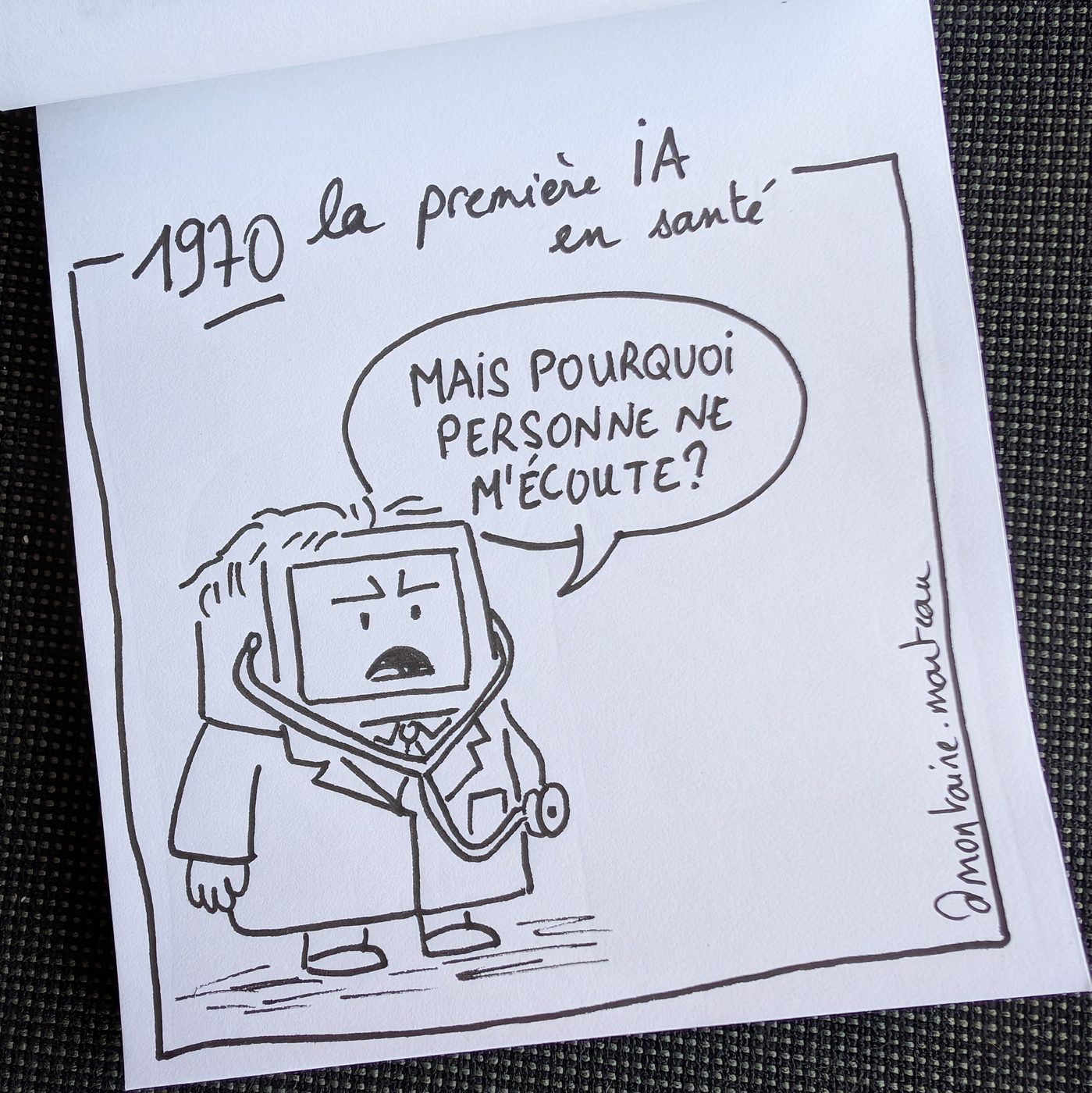
AI in healthcare: chronicle of a summer
MYCIN made better diagnoses than some doctors… in 1972. Where do we stand today? An exploration of medical AI through the prism of those who live with it: patients, carers, data scientists, decision-makers, citizens.
This summer, I published a few posts on AI in healthcare. I looked at it through the prism of those who live with it: patients, carers, data scientists, decision-makers, citizens… Here they are, gathered together, episode by episode.
Episode 1 — MYCIN, 1972: the AI that diagnosed better than some doctors
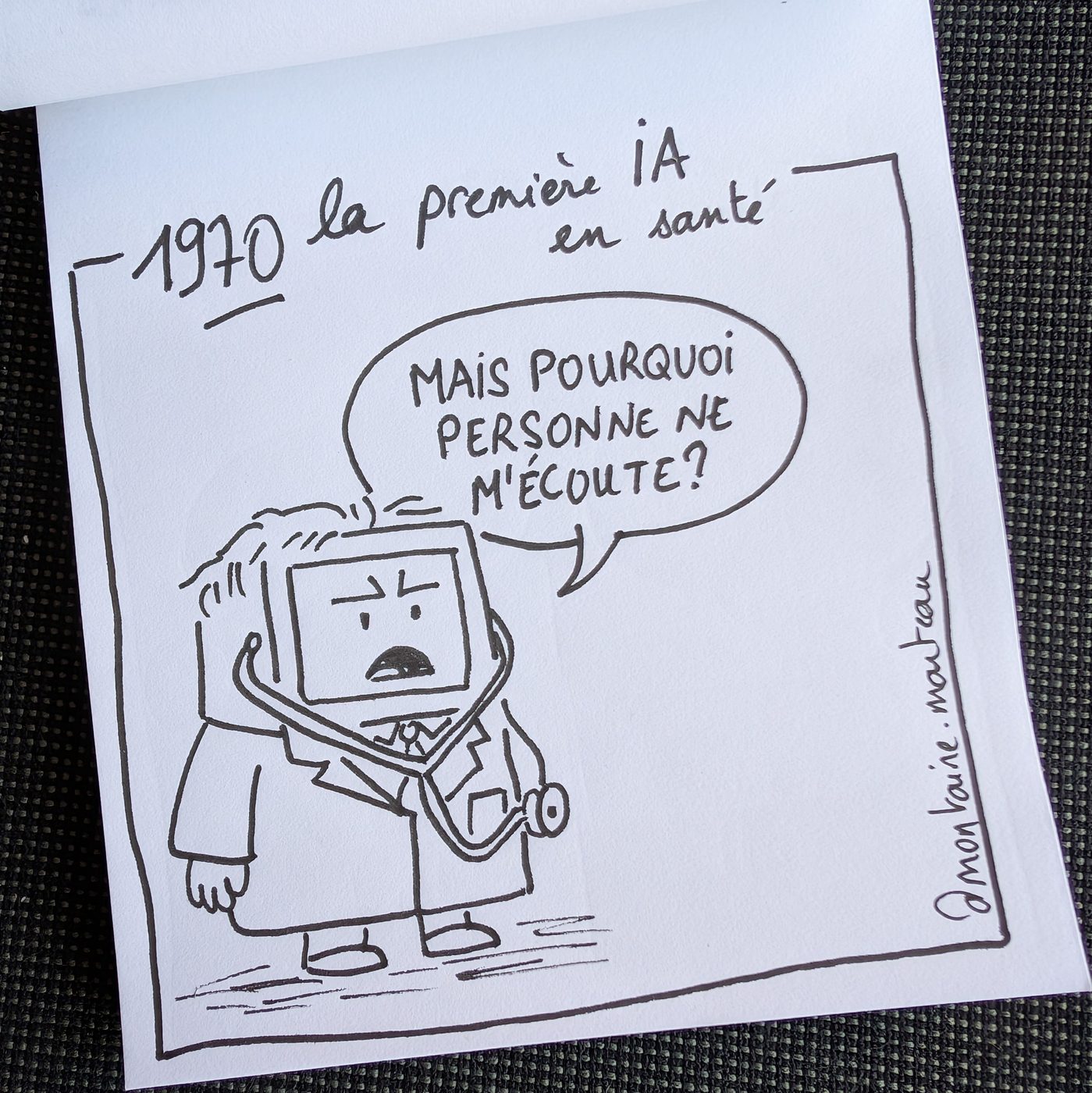
MYCIN, 1972: the AI that made better diagnoses than some doctors… but that no hospital was willing to use.
Developed at Stanford, MYCIN was a rule-based expert system (in the LISP language) designed to help diagnose serious bacterial infections such as septicaemia or meningitis, and to recommend a suitable antibiotic treatment.
It worked like a doctor questioning a patient:
- What symptoms?
- What body temperature?
- What colour is the cerebrospinal fluid?
- Which bacterium was identified in culture?
- How sensitive is this bacterium to a given antibiotic?
MYCIN asked 20 to 25 questions on average, chosen dynamically according to the previous answers. It then used a base of more than 450 'IF… THEN…' rules to infer a probable diagnosis and recommend the right antibiotic, with dosage and duration.
And it also explained why it suggested a given option, by retracing the logical chain of its rules. But this purely logical reasoning was not enough to reassure doctors or to meet the clinical requirements of the time.
In a blind study (Yu et al., JAMA, 1979), expert infectious-disease specialists judged its recommendations to be as good as, or even better than, those of practising doctors.
But despite this performance, MYCIN was never used in a hospital. Because it had no legal status. Because its reasoning remained too much of a 'black box'. And because in 1972, we were not ready to entrust medical decisions to a machine, however competent.
Too far ahead of its time. And where are we now?
Episode 2 — 75% of approved medical AIs involve imaging
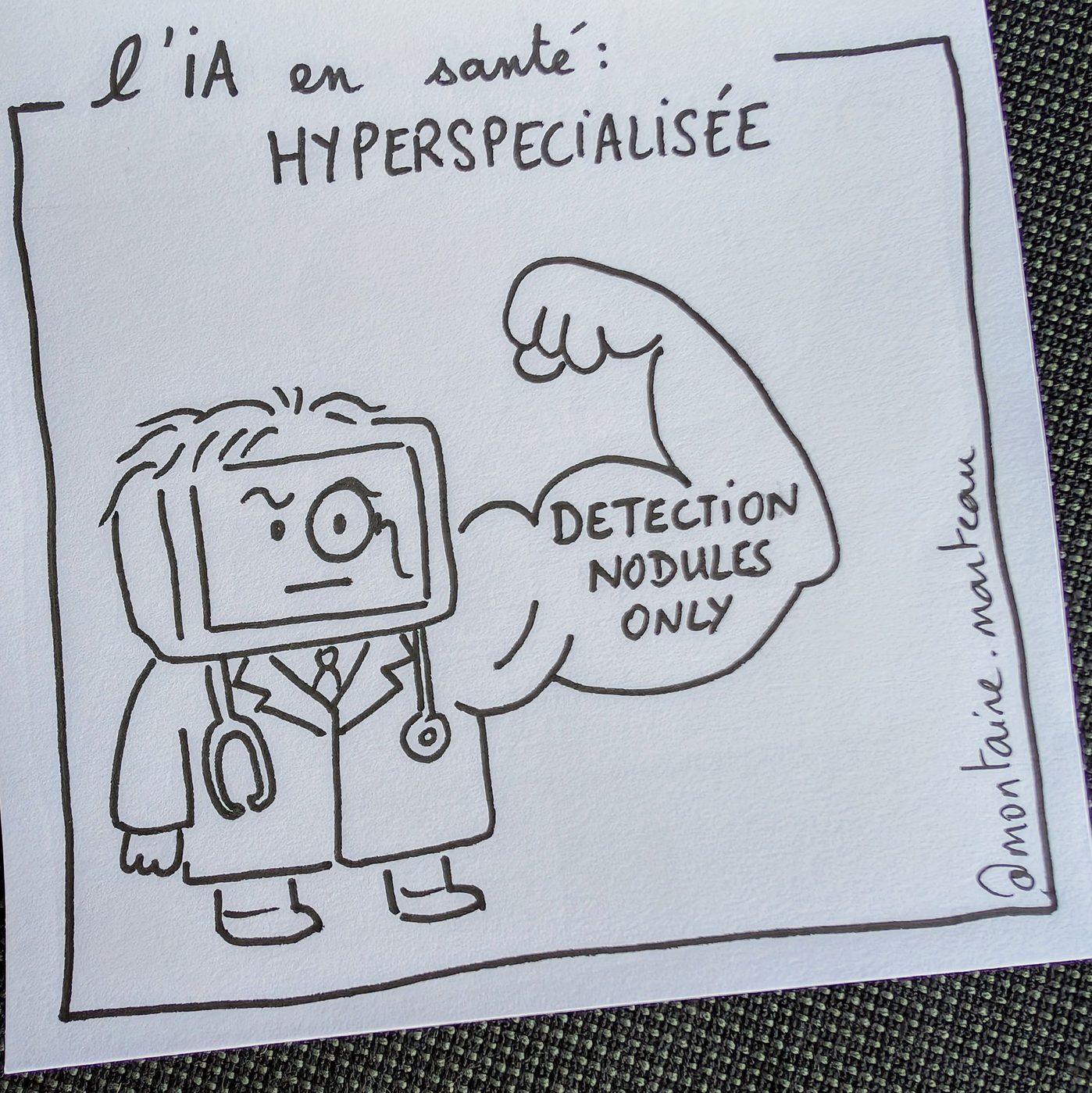
75% of approved medical AIs involve… imaging. Very precise, very technical tasks:
- detecting an anomaly on a CT scan,
- triaging chest X-rays,
- measuring a tumour on an MRI scan.
AI in healthcare is not ChatGPT. It is not a generalist AI. It is a hyperspecialised AI, trained to do a single thing, very well.
And these AIs are not prototypes, they have been in production for several years: 66% of radiology departments in the United States already use at least one AI, 48% in Europe. These tools are built into the workflows.
Why does imaging concentrate so much AI?
- Because medical images are digital and standardised (DICOM).
- Because radiologists already annotate images in their everyday practice: they identify lesions, locate them, measure them, characterise them.
- These annotations are stored in archiving systems (PACS) and can serve, directly or almost, as a training base for the models.
No need to recreate everything. The data is already there: usable and qualified. In other specialties, the data is textual, unstructured, often partial. It is often more complicated.
If we look at the use of AI in healthcare as a whole:
- Between 2015 and 2024, the FDA approved 915 medical devices incorporating AI or machine learning, with a sharp acceleration in recent years: nearly 200 approvals in 2023.
- In France, more than 80 hospital AI projects have been funded since 2019, as part of the national IA Santé programme, supported by France 2030 and the Plan Innovation Santé 2030.
Episode 3 — Is the patient better cared for, or forgotten in the data?
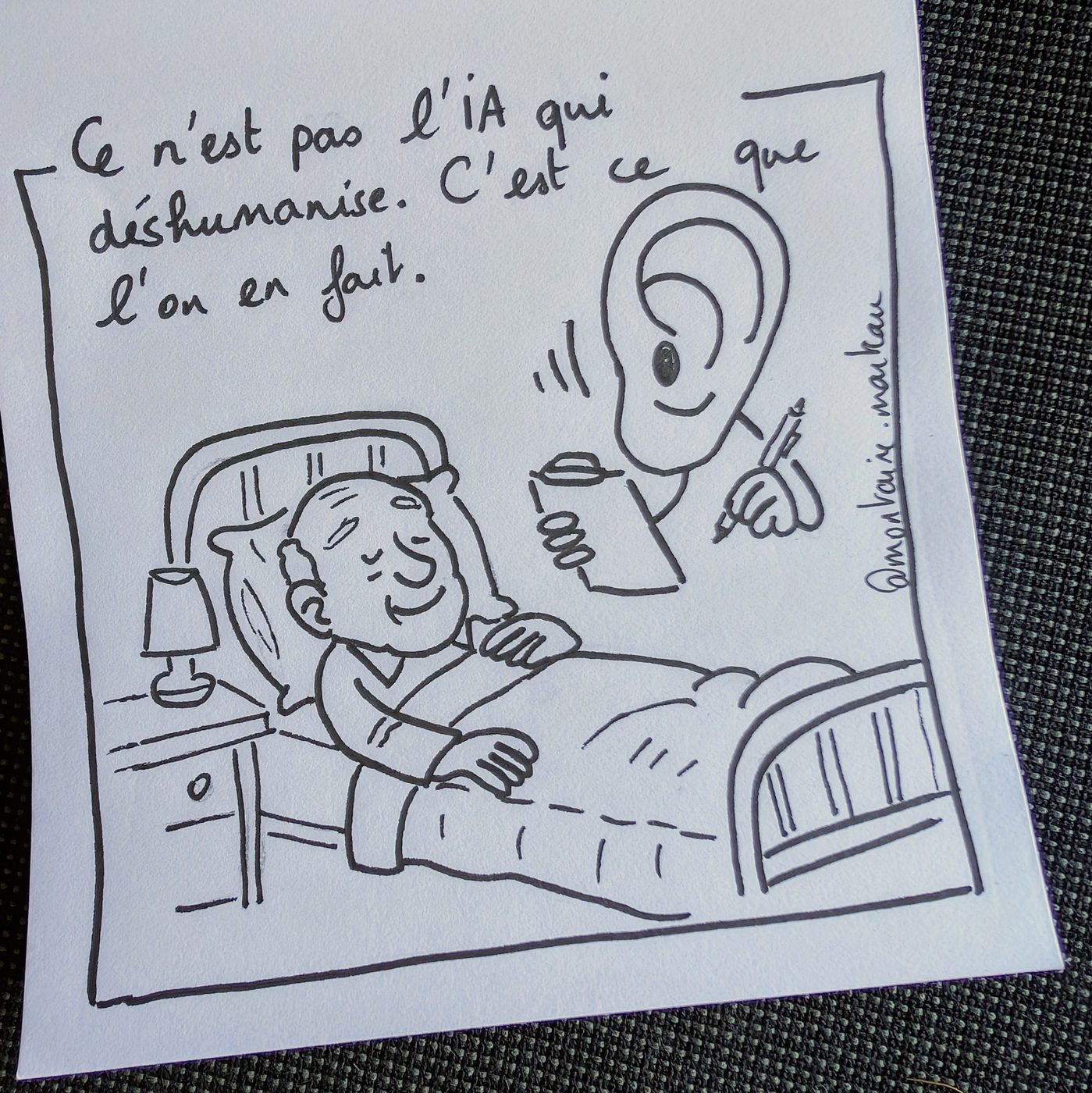
To be listened to. Seen. Taken seriously. That is what many patients expect from a consultation.
And this is not a 'subjective' expectation: the quality of the doctor-patient relationship improves treatment adherence, reduces anxiety, and even has a measurable clinical impact. It is taught in medical school. We know it.
But in practice?
- We are short of time. A consultation lasts 16 minutes on average, with an interruption every 10 minutes.
- We are short of carers. 63% of French people have already forgone care, for lack of a practitioner or because of waiting times.
Can AI be a solution? Can it give us back time for care?
One example: the connected ear from OSO-AI, a sound sensor that detects falls, distress and cries in care-home rooms. The aim: to strengthen safety and avoid unnecessary night-time visits. The promise: more peace and quiet for the patient, more availability for the carer.
Yes, it has been shown that this type of AI improves care. But I am not convinced by what we, as humans, are going to do with it. If it is to cut teams, then it would be a step backwards, not progress.
Yes, the patient-doctor relationship is crucial. But it is not the algorithm that dehumanises. It is the decisions around it.
Episode 4 — It is not AI that replaces social connection, it is its absence that makes room for it
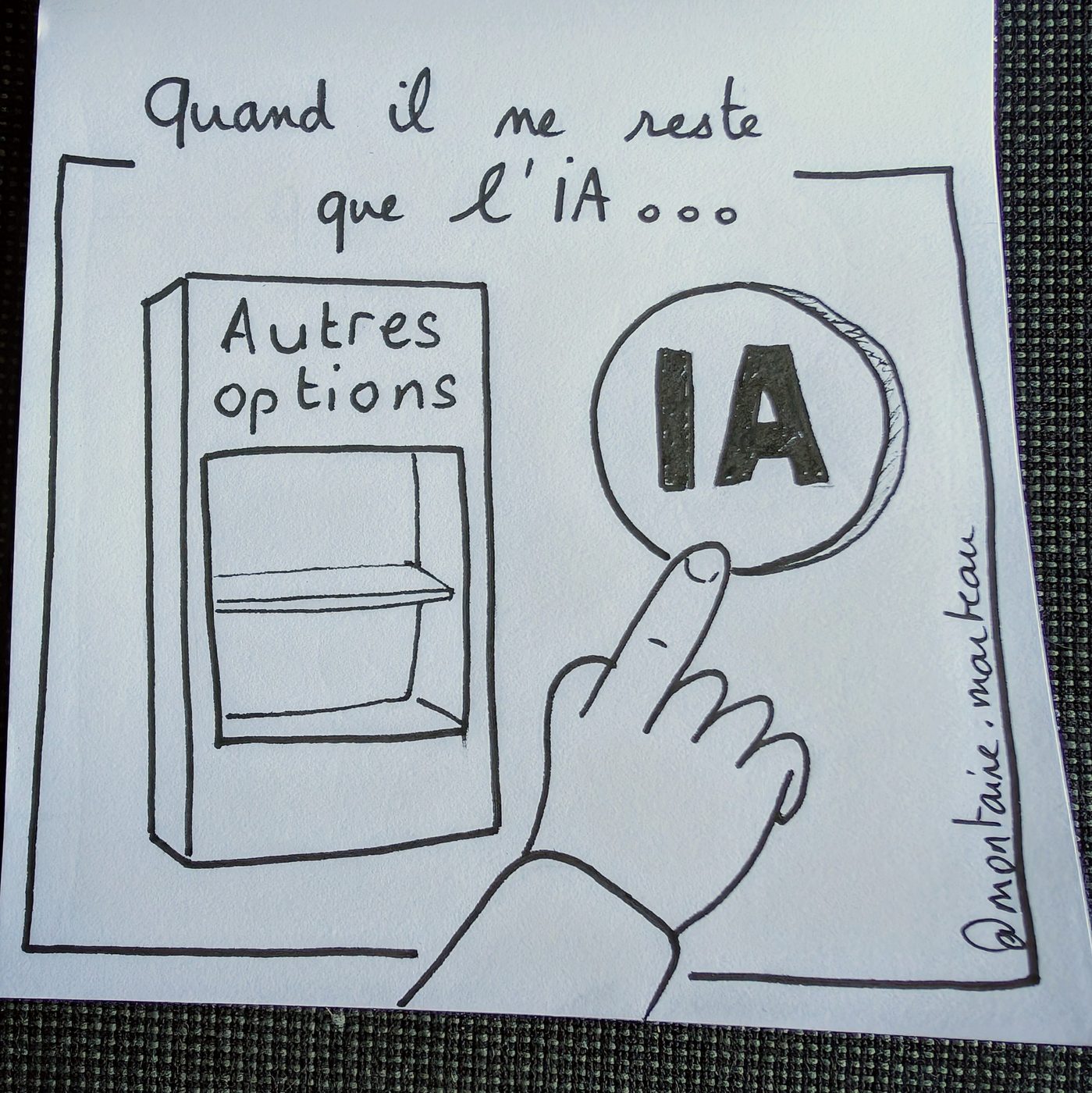
The evenings were the longest. After the meal, often a soup, a yoghurt, a rusk, Jeanne would turn off the television. Too much noise. Too much emptiness, once the programme was over.
She no longer really went to the activities at the centre. It cost a little, she had to take the bus, and she did not like to ask. And then, deep down, she was not quite sure what she would have said to the others. The children? They did what they could. A phone call on Sundays. Sometimes.
So when the nurse offered her a little tool to chat with in the evening, she accepted without really believing in it. A tablet. An app. All she had to do was talk. And it replied. It remembered her cat, asked her questions about the garden, said good evening to her using her first name.
It was strange. But comforting. She did not talk about it. People would have thought she was losing her mind. But deep down, she felt less alone. Not happy, no. But a little less absent from the world. She did not know if it was normal. But it was there.
Jeanne's story, imagined while reading an article in the New Yorker.
Recent studies have shown that conversational AIs can temporarily reduce the feeling of loneliness, particularly among elderly or isolated people. The key factor? The feeling of being listened to. In some cases, chatbots are even judged more empathetic than human carers.
But these positive effects mask a more complex reality. When social connection is absent or degraded, AI does not replace it: it stands in for it by default. And in the long term, intensive use is associated with:
- a reduction in real social interactions,
- a form of emotional dependence,
- a deactivation of the inner signal that usually drives us to seek out others.
It is also important to look at the conditions under which these technologies are adopted. Turning to a human alternative often requires time, people around you, money. It is not always possible. AI is not always a choice. Sometimes it is the only solution available in a constrained context. That does not make it perfect. But it explains why it can meet a real need, even when it is imperfect.
Episode 5 — AI alone, doctor alone, or the two together: which do patients prefer?
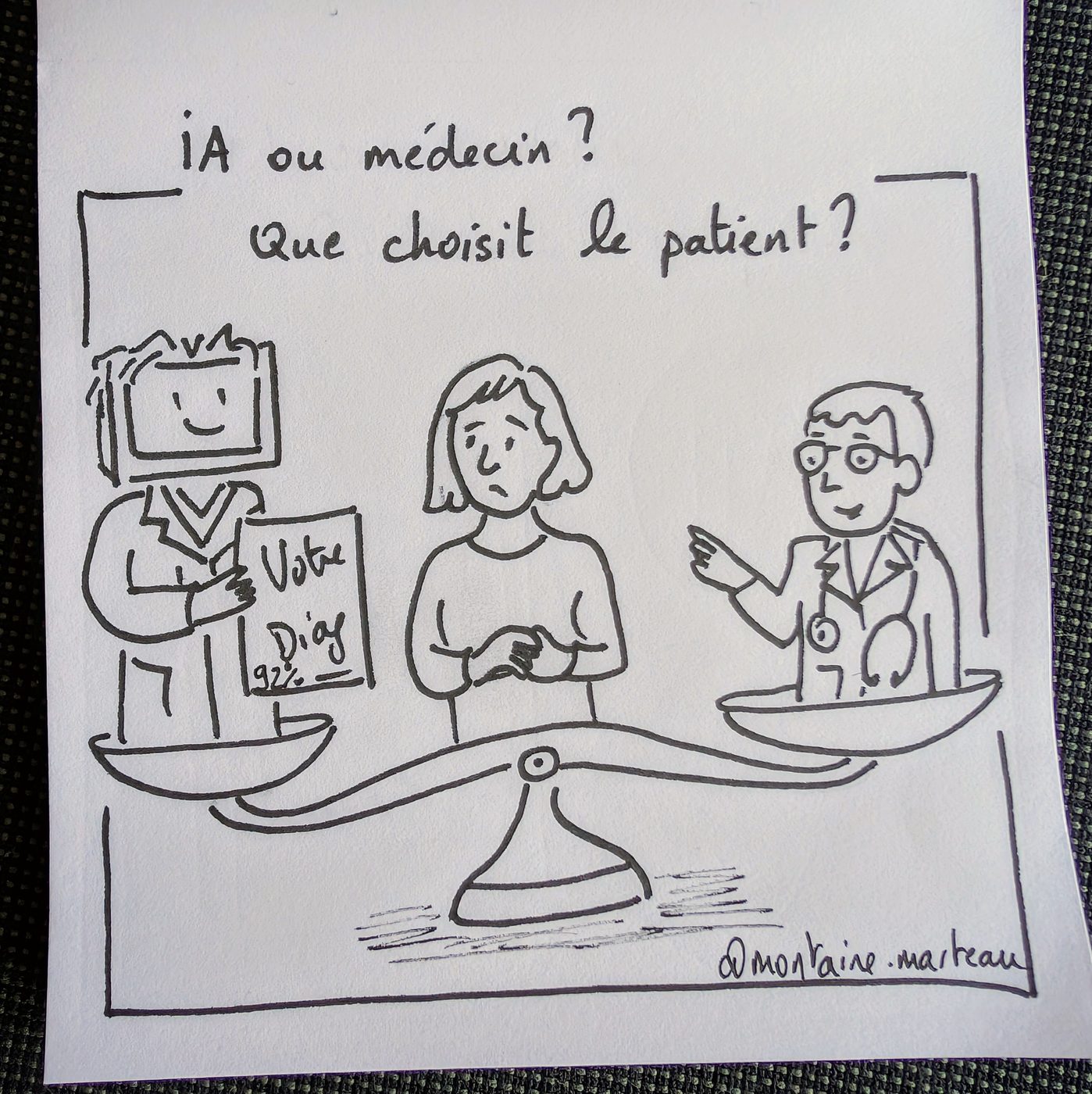
A patient, Élise, 47, suffers from recurrent abdominal pain. She sees a doctor to find the cause.
AI alone. Élise receives a secure message: 'Your data has been analysed by our medical AI system. Main hypothesis: irritable bowel syndrome. No warning signs. Recommended treatment: protocol B. Click here to accept.' She reads it three times. Then puts her phone down. That evening, she books an appointment… with a human doctor.
Analysis: the absence of an understandable explanation, human validation and an identified contact undermines the relationship of trust. The content is not called into question, but the way it is delivered creates immediate doubt.
Patients show significantly lower trust when they realize a decision was made by an AI system without human oversight.
Doctor alone. The doctor sees Élise, listens to her at length, takes notes, examines her. Then says: 'I think it is a functional disorder, nothing serious. We will try a gentle treatment.' Élise nods. Then asks: 'Are you sure? Have you seen this often?' The doctor replies: 'I rely on my experience.' Élise smiles… but is left with a doubt.
Analysis: the human relationship is present and engaged. But without explicit or third-party data to back it up, the reasoning is still perceived as subjective.
Patients report greater confidence when clinicians combine their judgment with data-based recommendations, rather than intuition alone.
The two together. The doctor welcomes Élise, listens, examines. Then says: 'I am going to consult our AI assistant. It compares your situation with thousands of similar cases.' The screen suggests a diagnosis: IBS. The doctor explains, comments, qualifies: 'It confirms my intuition. But the decision remains ours.' Élise breathes deeply. 'OK. We move forward together.'
Analysis: the balance between clinical expertise and algorithmic support fosters understanding, transparency and trust. AI is perceived as a tool that reinforces care, not as a substitute.
The highest levels of trust were observed when AI-assisted decisions were accompanied by clear human involvement and explanation.
These stories are of course simplified. But they illustrate a central point: the quality of acceptance depends less on the technology than on the conditions in which it is integrated. The determining factors are known: trust, explainability, human oversight, accountability, and the handling of emotional reactions.
No great surprise… when patients have the choice, they favour the human relationship reinforced by the support of AI.
Episode 6 — You are ill, but the AI does not see you
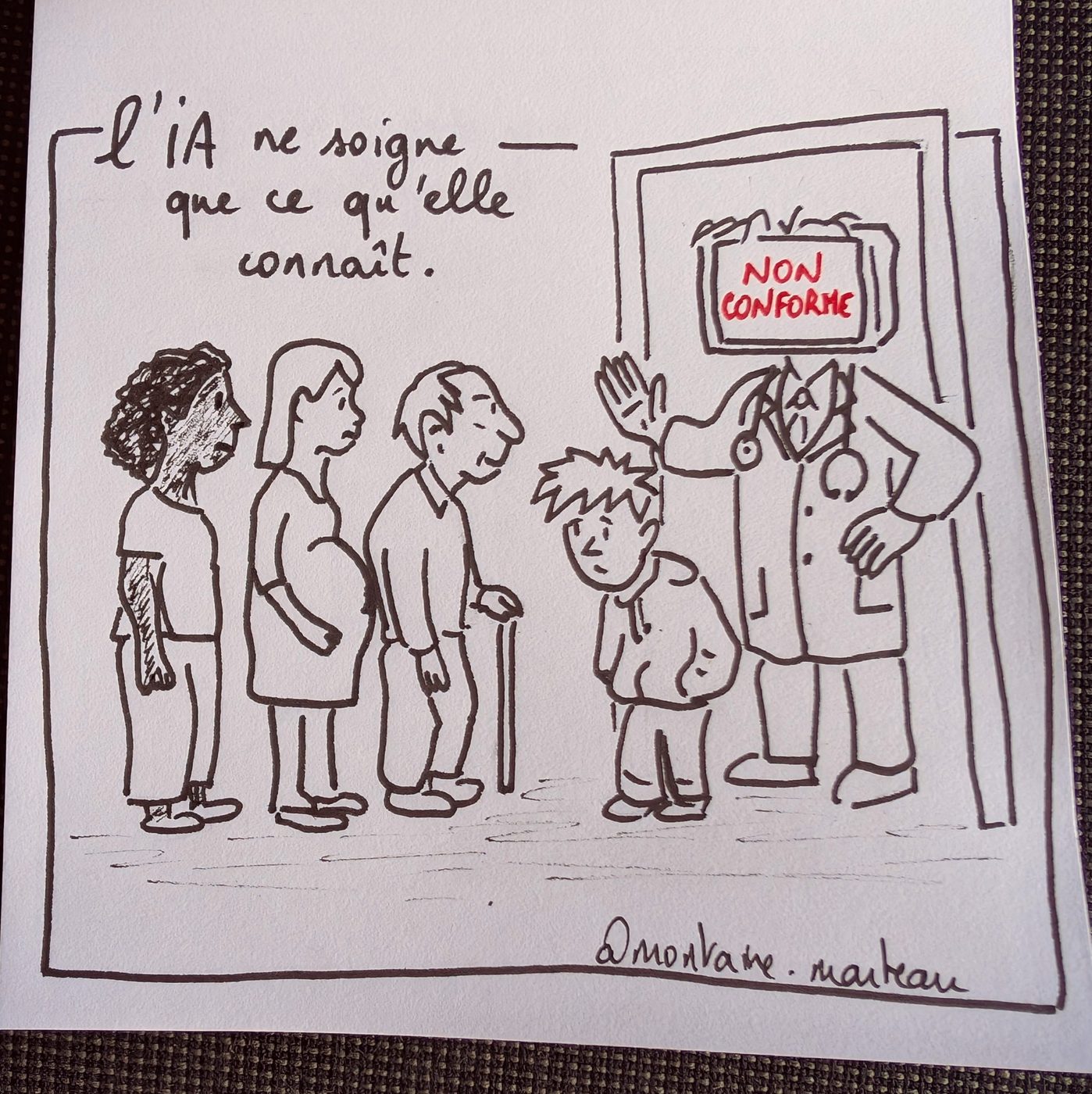
Why? Because you were not in the data. Because you do not look like the 'typical' patients it learned from. In concrete terms:
- Are you a woman? Your heart attack gets missed.
- Are you Black? You are given lower priority in care.
- Do you have dark skin? Your skin cancer is poorly detected.
- Are you elderly? Diagnoses go wrong more often.
- Are you in a precarious situation? You are never considered ill.
- Are you pregnant? You are not taken into account.
These are not bugs. They are biases. And in healthcare, a bias can kill. Which biases does medical AI reproduce?
Perception bias: what AI sees badly
Gender bias. Up to 10 points lower on some cardiac models for women. Their symptoms are less well recognised, because the training data is male.
Skin-colour bias. 90% of training images come from light skin. Lesions on dark skin are less well detected.
Age bias. 4 in 10 cases of osteoarthritis go unnoticed in elderly people. Their data is under-represented in the training sets.
Judgement bias: what AI assesses badly
Racial bias. For equal severity, Black patients receive 15 to 20% less care. The AI bases itself on past spending, which reflects inequalities.
Socio-economic bias. Among the most deprived patients, key information is missing (for example, asthma severity is absent in 41% of cases against 24% for better-off patients). The AI confuses absence of data with good health.
Usage bias: what we delegate to it too much
Body-normalisation bias. 95% of clinical trials exclude pregnant women. These AIs generalise badly: they are calibrated on standard bodies.
Automation bias. 7% of experts correct a good diagnosis by following an erroneous AI. Excessive trust is placed in the AI's predictions, even when it is wrong. This reinforces the impact of the underlying biases.
To go further: the European Data Protection Board (EDPB) offers a guide to detect and limit these biases, through data diversity, subgroup evaluation and human oversight.
These biases seem obvious with hindsight.
Sources and references (4)
- MYCIN study: Yu et al., JAMA, 1979.
- Episode 4: story inspired by an article in New Yorker; studies on the effect of conversational AIs on the feeling of loneliness.
- Episode 5: studies on patient trust in AI-assisted decisions and human oversight.
- Episode 6: work on gender, skin-colour, age, racial and socio-economic biases in medical AIs; exclusion of pregnant women from clinical trials; automation bias; guide from the European Data Protection Board (EDPB).

Product, innovation and MedTech field notes
Frameworks, methods, field feedback. Let us talk for 30 minutes to see what applies to your context.
Book a slot →
Thank you. Your comment will be published after review.